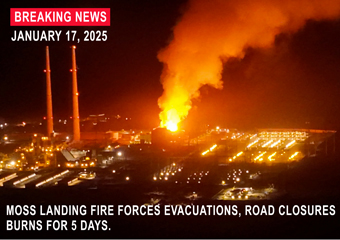
This new technology has the potential of fires that cannot be extinguished. In 2023, 4 out of 8 battery energy storage systems (BESS) in New York experienced fires. The fire in January 2025 at the Moss Plant in California burned for 5 days, releasing toxic smoke containing heavy metals. Local officials described the fire as a worse case scenario that no one predicted. Local residents reported a range of health issues. Scientists from San Jose State University found toxic heavy metals in the soil, hundreds to thousands of times higher than before the fire, despite the Environmental Protection Agency's initial claim the fire did not release toxins. The fire forced evacuations, shelter in place orders and road closures. Orange County Supervisors passed a moratorium on BESS facilities to give them more time to consider the risks posed.
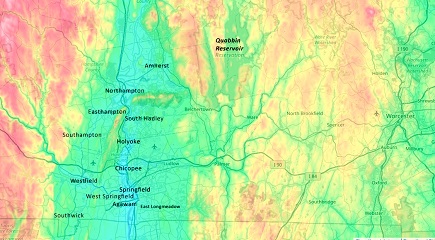
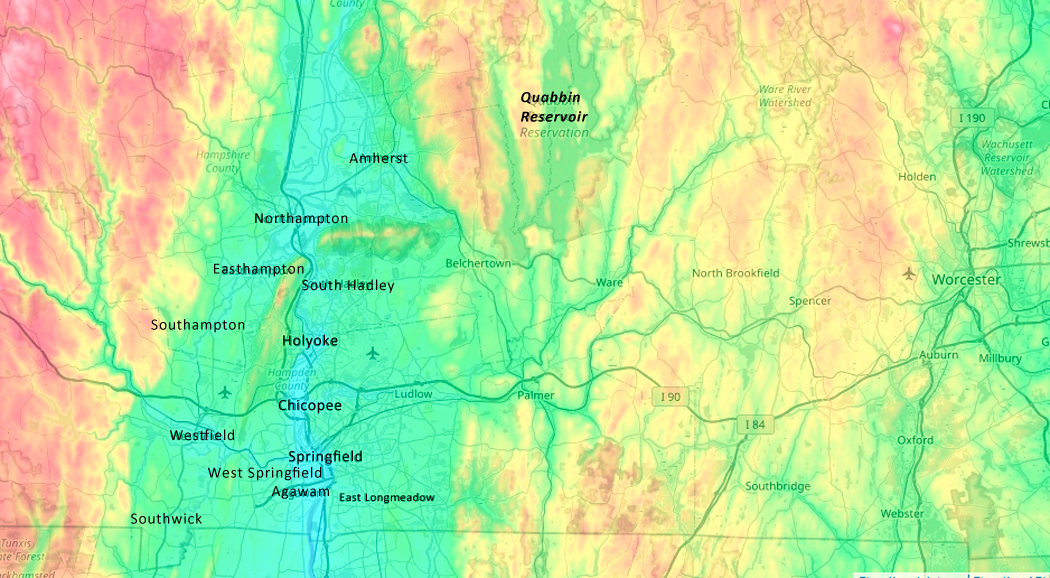
Westfield and nearby cities are connected in the Connecticut Valley River basin
(click above) by low elevations, ranging from 54 to 248 feet above sea level, and surrounded by mountains. The Holyoke Mountain Range average height is 900 feet, the Worcester hills 600 feet and the Berkshires 1200 to 1724 feet. These low-lying areas trap air, contribute to weather inversions, which can worsen air quality. This is one reason the Springfield area ranks among the highest in the nation for asthma and other respiratory conditions. The toxic smoke, poisonous gases and heavy metals from a fire lasting 2 to 5 days would not be confined to the proposed site. Fumes would become concentrated in the valley, but could travel 35 to 50 miles. Portions of UMASS – Amherst are only 54 feet above sea level.
Westfield is the pre-glacial route of the Connecticut River. 10,000 feet of ice formed the Holyoke Mountain range. The river was cut off and diverted to the other side of Holyoke and the Oxbow in Northampton formed. Due to the valley's topography, pollution from a fire could spread to Southampton, Easthampton, Northampton, Amherst, West Springfield, Springfield, Holyoke, Chicopee, South Hadley, Agawam, Southwick, the Barnes Aquifer, the Tighe-Carmody and Quabbin reservoirs, Boston's drinking water supply.
The lithium fires led governors in California and New York to call for investigations, and officials filed legislation to pause siting lithium battery storage sites, require buffer zones between battery storage sites and communities or ecologically fragile areas, and mandate local engagement in permitting, rather than allow state agencies to approve on their own.
"Clean energy" technology should not pose a risk to our first responders, communities, the environment or our drinking water. Massachusetts should be proactive and learn from other states. We all want safe, reliable, efficient and affordable energy. We have a right to clean air, water and soil. We cannot take the risk that nothing bad will ever happen.
Dan Allie, Westfield City Councilor
Finished reading